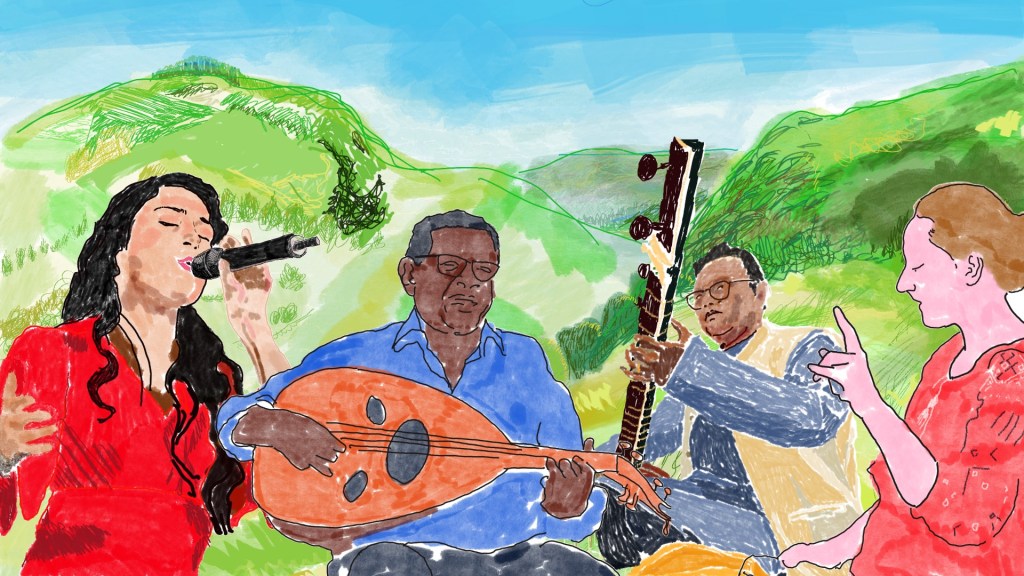
Carnival Against Fascism was a collective response to a far right threat to our city. In March 2026, multiple far right groups announced their intention to march through Brighton on June 13th. The day before national Refugee Week started. Communities in Brighton began work together to stop them. Thanks to everyone in the city for their work and to Laila for her thoughts on the day…
Guest post by Dr Laila Kadiwal
The politics of hate came to Brighton, and was defeated. As a woman of colour, I am proud of my city
The politics of hate came to Brighton.
On Saturday, 13th June, around 300 far-right supporters arrived at Brighton Station to march through Brighton. Many of these individuals may be open to dialogue, where common ground can be found around shared grievances linked to entrenched inequalities and policies that fail to serve communities. Creating spaces for such conversations is therefore essential.
However, the ideology of fascism and the far right funded by the world’s first trillionaire and billionaires, deliberately diverts attention away from the root causes of global inequality, planetary crisis, and injustice. Instead, it redirects ordinary people’s anger downward, targeting those who are more vulnerable. It scapegoats refugees and migrants, abuses queer and trans communities, spreads misogyny, denies climate injustice, and circulates conspiracy theories. It ultimately serves no one, including those who support the far right.
One of the more concerning concepts associated with the far right is “remigration”. It calls for the mass forced deportation of people of non-white heritage or those from minoritised backgrounds, often beginning with those labelled “illegal”. While framed in the language of bureaucracy, nationalism, and national security, the concept is widely viewed as a euphemism for ethnic cleansing. We are already witnessing variations of this idea in places such as the USA, India, and elsewhere.
This ideology also fuels fears of demographic replacement, in which the majority population is portrayed as being at risk of being replaced by vulnerable, minoritised groups. These anxieties are framed as threats to women, the nation, culture, religion, identity, and jobs, and are often coupled with a nostalgic appeal to a so-called “glorious past” that must be restored. We are witnessing the rise of this politics of hate and division across the world.
In this wider context, the politics of hate arrived at Brighton Station.
****


But what did Brighton do?
Brighton came together.
Thousands gathered to block every street around Brighton Station, effectively containing the far-right group within a small area in front of the station. Around 300 of them attempted to march along Surrey Street but were met and blocked by thousands of anti-fascist protesters. They then tried to move via Terminus Road, only to be stopped again before proceeding to Trafalgar Street. There, police used horses, pepper spray, and physical force against anti-fascist protesters in an attempt to clear a route into the town. Despite this, thousands of anti-fascist protesters moved with agility across different streets, holding the line. Tired and exhausted, the far-right group eventually gave in and dispersed.
The symbolism of this entire episode was profound.
Five things stood out to me
1. Young people and queer solidarity groups were highly visible. Hundreds of young people and members of queer solidarity groups came out to stand against fascism, offering a strong sense of hope for the future. At one point, later in the day, a group of about ten drunk young men walked past, shouting anti-trans and anti-gay slogans and making threats of rape. A small group of young queer people called them out.
2. The diversity of the local community. The antifascist resistance reflected the breadth of Brighton’s population: people of different ages, backgrounds, religions, lifestyles, and sexual orientations. In contrast, the far-right group appeared far more homogeneous.
3. Unity across local and political groups. In standing against fascism, the local community, Brighton and Hove Council, the Green Party, Your Party, and the local Labour Party stood together.
4. An intersectional shared struggle. There were banners and groups representing a wide range of causes and identities: trade unions, university unions, Palestine flags and keffiyehs, Sussex Jews, queer solidarity groups, Young Socialists, labour organisations, educators’ unions, journalists, climate groups, refugee support groups, women against fascism groups, and organisations addressing global inequalities, alongside singers, DJs, drummers, and artists.
In contrast to claims of identity politics which seeks to erase diversity of struggles and creates a hierarchy of oppression, this mobilisation recognised diverse experiences of discrimination while building shared resistance to billionaire-driven politics of hate and exclusion.
I encountered a pro-Palestine protester sitting at a bus stop in tears. Her son is half Palestinian and half English. She had been dismissed by another anti-fascist protester who did not accept that Palestinians were experiencing violence. Yet, another anti-fascist sat with her and carefully explained why a commitment to anti-fascism must be intersectional. Earlier, I had met a young British Jew wearing a watermelon kippah. His group announced that they were opening a synagogue in Palestine House.
5. Community-led, grassroots organising. This was not a leader-led mobilisation but an organic, community-driven effort built over two months of organising, largely led by queer and trans groups. They worked to bring people together holding space for diversity of struggles, recognising that fascism affects everyone. It was a powerful example of intersectional grassroots solidarity in action.
6. Ethic of care. There was also a powerful ethic of care within the mobilisation. People with legal expertise went to police stations to support any anti-fascist protesters who were arrested. Others consciously used their privilege to stand on the front lines, helping to protect those from minoritised backgrounds in case of attack.
Many local community members gathered around detention hotels where refugees are housed, ensuring their safety, mindful of past incidents where such spaces had been targeted. At the same time, singers sang, drummers drummed, and dancers danced. A dear white friend of mine of Jewish heritage stayed close by my side, keeping an eye on me and moving where I moved, aware that, as a racialised woman, I could be more vulnerable to a racist-sexist incident. I introduced her to a young member of the group opening a synagogue in Palesteine House. She felt happy to get to know him.
By the end, several hours later, I felt outraged, saddened, and proud,
I felt outraged that so much public money was spent on protecting a fascist ideology, when those resources could instead support community wellbeing and planetary futures, bringing people together across—addressing the conditions that allow such ideologies to grow.
And yet, despite this, the grassroots movement demonstrated something powerful. It stood up to toxic, violent, supremacist, heteropatriarchal politics, which justify inequality and exclusion.
And Brighton did it with grace. There was dancing, music, rainbow colours, bright costumes, singing, agility, and radical joy. People looked after and protected one another.
There were also moments of police violence against anti-fascist protesters, and many moments of camaraderie.
At the end of the day, I, British, of Indian origin, walked home, alone, feeling safe.
Thank you, Brighton.
****
“What made you join the protest today?”
I randomly asked members of the Brighton community.
From a small sample (n=12), four key reasons emerged:
1. Defence of Brighton’s inclusive identity and opposition to fascism
Many expressed pride in Brighton’s inclusive ethos and clear opposition to far-right values:
“They are bringing fascism, I am not going to support fascism. “
“Fascism, not in my city. I grew up in this city, and this city is not about that.”
“To fight the Nazis. This is a liberal city. I do not want the influence of the Nazi on this city.”
They were there to protect what Brighton represents:
“Rejection of hate and the far right ideology, and the celebration of what is best about Brighton.”
“Brighton is an inclusive place; if you cannot show up against fascism here, where will you?”
“Brighton has an inclusive ethos. I don’t want it to be affected.”
2. Fear and concern for the safety of the city
Many participants expressed genuine fear, shaped by events elsewhere:
Having seen images of pogrom in Belfast, arson in Southampton, attempted attacks to torch the hotel with refugees, and the burning of a mosque in a town near Brighton not long ago, some were deeply worried about what might happen to the city, if the march proceeded.
“They are terrorising my city.”
“These people are terrorising my community.”
“I am terrified of what they can do.”
People came out, in part, to protect their city.
3. Solidarity with those being targeted
As far-right rhetoric called for the deportation of migrants, Brighton responded with:
“Say it loud, say it clear, refugees are welcome here.”
Participants emphasised solidarity with more vulnerable groups in society:
“I want to show support for immigrants.”
“Because, I am not racist. Everyone is welcome here.”
“I work in the NHS, it is run by migrants. It will collapse without them.”
One response stood out particularly:
“The reason is two-fold. I am Ukrainian. I am a migrant to the UK myself. If they come after other migrants first, I am going to end up being there on the chopping block next, removed from the country, just because I was not born and brought up in Brighton. Silence is complicity. I need to go out to the street to support people in a situation similar to mine. I am there for them. If I am not, what kind of person am I? I am not entitled to be protected when they are not.”
Others echoed similar commitments:
“I am here because I am against all forms of prejudice and bigotry.”
“I am here because I am from a mixed family and I am against prejudices.”
“I don’t like scapegoating, I don’t like far-right values. I do not like racism. I do not like their philosophy.”
4. The desire to visibly outnumber the far right
Many wanted to send a clear message:
“I am here because I want those people to know they are outnumbered. “
“Because I want to show them that they are outnumbered. I want to break their bubble, and if they think they have support, I want to let them know that they don’t.”
****
The Nelson pub was filled with anti-fascist protesters at the end of the march. People exchanged observations, and smiles, also sighed with relief. Our friends shared how they had to spend £12,000 at the Home Office so that the wife, from a Turkish background, could stay in the UK and secure the right to family life with her British husband and their British son after a long, humiliating and hostile immigration process.
Another friend and I reflected on how, next time the far right chose to march in Brighton, thousands of us might instead host a tea party with cake, calling them in. We imagined this as a space for dialogue about the inequalities and policies that continue to fail all of us. While there are those who wish to harm you because of how you look or your social identity, there are also some who may be seeking a space for conversation.
****
I felt outraged, saddened, and proud,
I felt outraged that so much public money was spent on protecting a fascist ideology, when those resources could instead support community wellbeing and planetary futures, bringing people together across—addressing the conditions that allow such ideologies to grow.
And yet, despite this, the grassroots movement demonstrated something powerful. It stood up to toxic, violent, supremacist, heteropatriarchal politics, which justify inequality and exclusion.
And Brighton did it with grace. There was dancing, music, rainbow colours, bright costumes, singing, agility, and radical joy. People looked after and protected one another.
There were also moments of police violence against anti-fascist protesters, and many moments of camaraderie.
At the end of the day, I, British, of Indian origin, walked home, alone, feeling safe.
Thank you, Brighton.


https://www.instagram.com/carnivalagainstfascism
